
Over the past twelve months, Capital Vintners and the wine market have experienced a particularly challenging period. Early signs of recovery in the first quarter were offset by the impact of U.S. tariffs and a difficult Bordeaux En Primeur campaign, both of which adversely affected trading activity and market pricing. Fortunately, in recent months, as tariff-related uncertainty has eased, we have seen clients returning to the market ahead of the holiday season, accompanied by a modest but encouraging improvement in both prices and trading volumes. We remain cautiously optimistic that this momentum will continue.
As Capital Vintners marks its twentieth year, we have taken the opportunity to reflect on how deeply appreciative we are of our customers and suppliers who have supported us throughout this journey. When I entered the wine trade in 1998, I envisioned creating a business that would broaden access to the fine wine market making it more open, efficient, and secure. Our goal has always been to simplify the processes of buying, selling, and collecting fine wine, thereby increasing participation, activity, and the overall scale of the market.
Looking ahead, we remain confident in the future. We are preparing to embark on a new chapter by expanding access to fine wines through our platform and by continuing to respond to our clients’ emphasis on comprehensive, accurate, and independent market data. We will be investing significantly to enhance these capabilities, rebuild our technology infrastructure, and position ourselves for the next twenty-five years of growth.
We are grateful to the many clients who have contributed their insights and helped us shape this forward-looking vision. Our intention is not only to make Capital Vintners more intuitive and user-friendly, but also to introduce new tools and products designed to help you make more informed buying and selling decisions.
In 2026, we expect our expanded investment programme to accelerate the pace at which we introduce new features and functionality to the Capital Vintners platform, better supporting the evolving needs of our customers.
On behalf of everyone at Capital Vintners, I would like to express our sincere thanks for your continued support and wish you a very happy Christmas and New Year.
————————————————————————————————————————————–
The Fine Wine Market in 2025 – source – Liv-ex
• A degree of optimism has returned to the market over Q3-4, with major Liv-ex indices rising consistently since September.
• With the introduction of tariffs, US buyers – 2024’s most significant buying segment – have taken a backseat this year.
• European buyers have stepped up, with total European purchase value up 48.2% year-on-year.
• Looking ahead, with prices showing stability and early signs of recovery on the Asian market, we consider what 2026 might have in store.

It took three years for the major Liv-ex indices to rise, but in September they finally did. They have since ticked up steadily each month, giving the fine wine market a degree of optimism as we head towards the end of the year. Before getting ahead of ourselves, a reminder of the full 2025 fine wine market performance.
After 2024’s consistent downward grind, this year started on a more positive note – trade value and volumes rose in the first two months, signs perhaps that the stock clear out was well and truly underway.
Then on March 13th President Trump threatened 200% tariffs on EU alcohol, a gut punch that winded the market. With April 2nd’s Liberation Day confirming tariffs on European wine at 15%, US buyers withdrew. This posed a problem to the fragile fine wine market.
The results were immediate – April saw the Liv-ex indices post their biggest losses since 2023, with regions like Champagne and Italy which had benefited from consistent US demand looking particularly vulnerable.
After a Bordeaux En Primeur campaign that saw many producers drop their prices only to find that collectors had lost interest, the market entered the summer lull.
Liv-ex 2025 monthly trade value and volume evolution
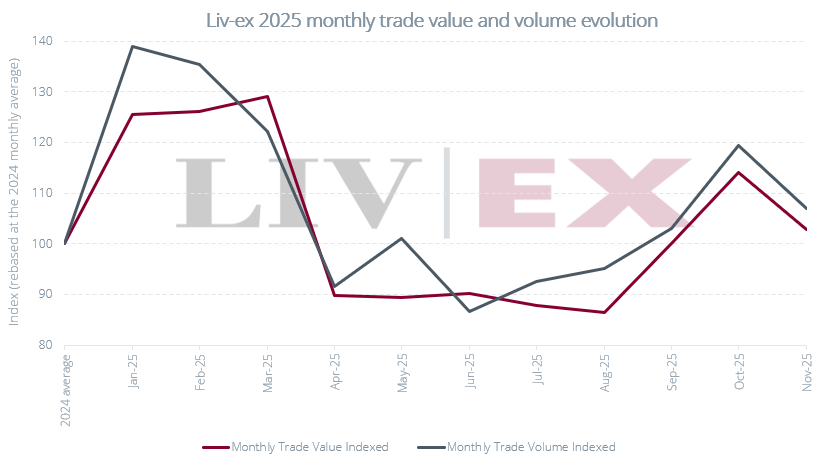
However, as merchants returned from the break, some positive signs started to emerge. Bid:offer ratios – a barometer of market sentiment and reliable indicator of future price movements – started to rise. Prices in turn followed suit, with major indices rising for three consecutive months from September. Trade value and volumes also rose in September and October, before falling back slightly in November.
The result of all this is total trade value is down 5.0% on 2024. On the other hand, trade volumes are 8.7% above 2024.
Wines traded on Liv-ex
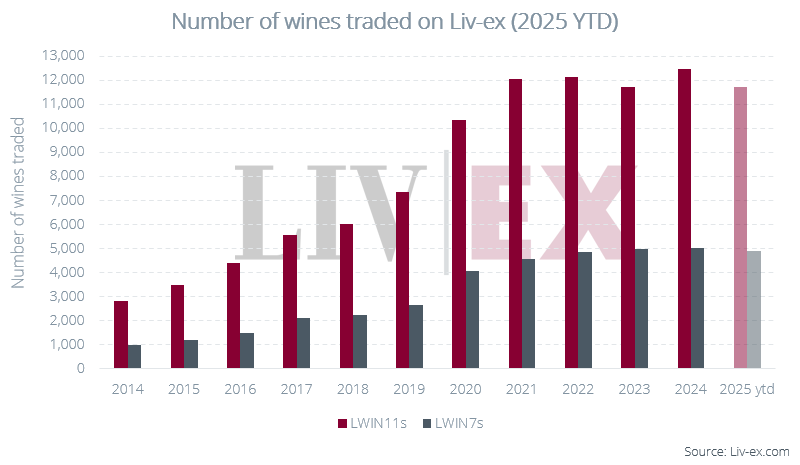
2025 is on track to close with a similar number of unique vintages (LWIN11s) and brands (LWIN7s) traded each year since 2021.
Conclusion
This time last year the outlook was bleak. We knew tariffs were likely and we knew prices had further to fall. What would happen if the US market withdrew? Would the Asian market remain stuck in the doldrums? Would the UK and European markets take up the slack?
12 months on, the outlook is more positive. While we are at the very start of the recovery, we now know the answers to some of those questions. Tariffs, while not welcome, have not been disastrous for the secondary market as a whole (US buyers will of course be feeling the strain). Prices have fallen but look to be stabilising, particularly at the top end. The Asian market is showing green shoots. The European market has stepped up, and looks set to continue to do so into next year.
We should underline again that we do not expect it to be smooth sailing from here. We anticipate that, as a whole, the market will bump along the bottom throughout 2026. This is an opportunity. The downturn has essentially been the result of a demand:supply imbalance. If prices remain where they are for an extended period, it gives new collectors the opportunity to buy and drink fine wine, building up sustainable long-term demand that stems from a passion for fine wine rather than the chance to make a quick buck. This will be critical as the traditional collector continues to step back, their cellars full.
What might the stumbling blocks be?
A small Burgundy 2024 crop will be released in January. We expect prices to be held roughly where they were for the 2023 campaign which itself was not a roaring success. As merchants reset in January, this could be an unwelcome challenge to overcome.
Bordeaux 2025 En Primeur. The very promising (if somewhat heat and drought-reduced) 2025 vintage will have to be released at prices that excite. Wines will need to be offered to end consumers at below the Market Price of comparable back vintages. Should stability continue to return in Q1, then an enticing EP campaign might come at the moment to kick the recovery into the next gear.
The US trade continues to lobby for wine to be excluded from tariffs. While US merchants will naturally have to continue to import European wine when stocks dwindle (or shut up shop), while tariffs are in play US demand will continue to be muted. A clear argument would be that if the lobbying efforts are successful and a true unlocking of US demand were to join increased European and Asian demand, then we would see the market decisively turn the corner.
The 2025 Liv-ex Power 100 – a wag in the tail
• The 2025 Power 100 comes as the market shows early signs of stability
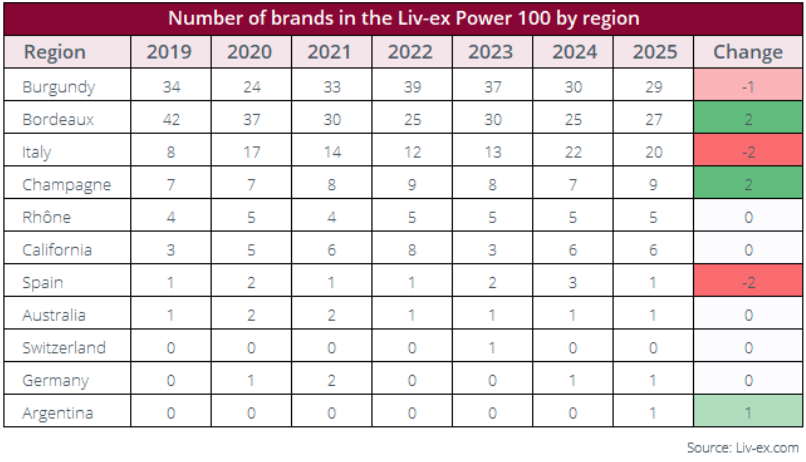
• Bordeaux and Champagne add two brands to the rankings this year, with Italy, Spain and Burgundy each featuring fewer brands
• Cheval Blanc climbs nine spots to top the rankings
Introduction
This Power 100 (fortunately) finds the market in a very different place than last year.
While some may have been cautiously optimistic at the close of 2024, 2025 has not been as kind to fine wine as they might have hoped. We might have endured a gruelling 2024, but 2025 cut even closer to the bone. The continuation of the downturn, another unsuccessful En Primeur campaign and the withdrawal of US buyers had a harsh impact on prices, and in turn, on businesses.
The summer progressed, and a mood of hopelessness took hold as prices continued to fall. What began as dejection, however, transformed into acceptance, and later into curiosity — could we have finally reached the floors we have been searching for since the turn of the market? Rising bid:offer ratios made clear that these new, lower prices were indeed beginning to appeal.
Last year, the questions on everyone’s lips were: ‘Are we reaching the bottom?’ and ‘How much further can the market fall?’ (‘No’ and ‘Until prices reach a point to clear out an excess of stock’, we answered).
As we moved into Q3 of 2025 however, a greater sense of agency emerged. The line of questioning shifted from the realm of ‘when will it end?’ into ‘what should I be buying right now?’. There remains an excess of stock, but there exists greater confidence that it will clear, and hope that profitable opportunities lie ahead.
While three consecutive months of rises in Liv-ex’s key indices have provided the market with some respite and cause for optimism, the year has been a rocky one. Last year, only 11 brands in the Power 100 saw their prices increase on average. This year, 35 did. Where last year active trade alone was enough to secure a place amongst the top brands in the market, this year required better all-round performance.
This year’s top performers are overwhelmingly comprised of wines that make sense to buyers — reasonable pricing, good liquidity and strong brand reputation all played key roles.
Bordeaux: a question of pricing
Cheval Blanc moved up nine places to claim the top spot as the year’s number one brand in the secondary market. It has not been immune to the downturn of the market – like almost all Bordeaux wines distributed En Primeur via La Place, it has faced declines post-release. But, through the past few campaigns, where other brands had taken advantage of better market conditions and found themselves in difficult positions when the market turned, Cheval Blanc implemented a more structured and consistent approach to their pricing. This has served the brand not only in its price performance, but in building its strong reputation for quality and relative value.
Yquem provides another example of how fair pricing can positively impact a brand. While falling from 5th to 8th place, to feature amongst the top ten – especially given weak demand for sweet wines in recent years – is a testament to the loyalty it has gained over time. Raising release prices might provide temporary gain, but the market rewards consistency and trustworthiness in the longer term.
La Conseillante’s impressive performances this year (up 89 places) can be chalked up to similar reasons. The chateau has been tempered in its approach to release pricing, continuing to provide the draw that Bordeaux was once well known for – exceptional quality in decent volumes at prices that lend themselves to drinking.
Pontet-Canet and Leoville Barton were the two Bordeaux to fall from the top 100.
Pavie and Angelus, both of which were reclassified as Premier Grand Cru Classe As in 2012 and, in turn, raised their prices, remained within the ranks but dropped several positions.
Petrus, Le Pin, Lafleur
Pomerol’s most tightly allocated wines – Petrus, Le Pin and Lafleur – all climbed the ranks in 2025. This was not a product of their price performance – all three continued to see declines – but of greater trade volumes and value.
The First Growths
Haut-Brion came first amongst the First Growths and was the only to feature amongst the overall top ten, thanks largely to its higher rank in price performance. Given the underwhelming price performance of Haut-Brion relative to its release prices in recent years, this may strike readers as counterintuitive. It was not the Grand Vin, however, driving its superior performance, but the Blanc, which saw its price rise by over 10% on average.
Burgundy: mid-range prevails
Given that most Burgundy brands produce multiple wines under both domaine and maison labels, the Power 100 is inherently skewed in their favour.
Domaine de la Romanee-Conti, Drouhin and Leflaive, ranking first, second and third by number of unique wines traded, were the primary beneficiaries of this.
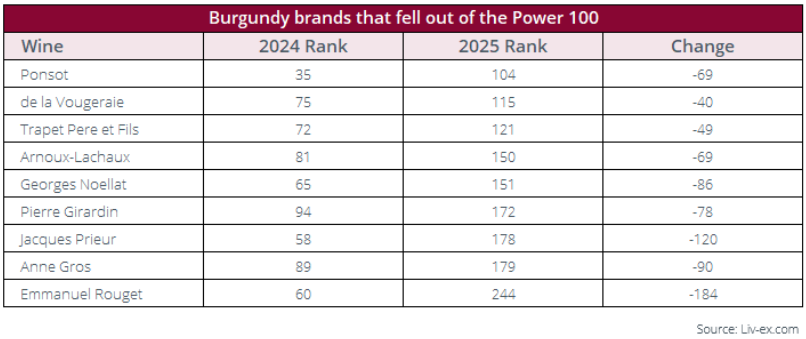
Nevertheless, Burgundy saw more brands enter and exit the Power 100 than any other region. This year, ten brands fell out while nine climbed in.
The climbers are relatively varied in style, but they are largely concentrated under the £2,000 per 12×75 mark – in the scheme of Burgundies, mid-range. In recent years, we have seen Burgundy’s share of the market grow, replacing Bordeaux for many as a dinner table go-to. Where Burgundy might once have derived its status from its investables, the market is growing increasingly partial to wines that lend themselves to uncorking.
Italy: Super Tuscans
Having taken Bronze last year, San Guido claimed Silver this year, solidifying its reputation as not only one of the most important, but most reliable brands on the market.
On average, prices of San Guido’s wines (namely, Sassicaia, though Guidalberto and Le Difese also saw some trade) rose 4.5%. As one of the most liquid brands on the market, it was its trade volume and value rank (6th and 4th respectively), however, that drove its performance.
Traditional Tuscan brands – Chianti and Brunello producers – fared less well, with five representatives falling out of the Power 100. This is likely to have been driven by the withdrawal of US buyers, who, over this period, have accounted for over half of the areas’ purchasing. Demand for Super Tuscans is, by contrast, more diverse.
While the breadth of Brunellos and Chiantis trading actively has slimmed, a select few have maintained or strengthened their positions.
Ornellaia, Masseto, Tignanello and Solaia sit substantially higher in the rankings, but Montevertine, Biondi-Santi, Marroneto, Soldera Case Basse and Valdicava make the grade nonetheless.
Champagne: Selosse and Salon enter the ranks
While upward movements of the Champagne 50 and improvements in sentiment around Champagne have only really come in fruition over the past two months (the Power 100 cuts off at the end of September) the region nevertheless performed well in the Power 100. Two new entrants into the 100 brought its regional total up to nine, matching its all-time best performance of 2022.
Jacques Selosse and Salon both entering the top 100 suggests some confidence returning to the market. For brands such as these – the cream of the crop – to rise again through the ranks, buyers must accept a level of risk (high prices and illiquid markets). As the market turns from a peak, buyers tend to steer clear of higher valued wines, from which they stand to lose the most. The opposite is true at the bottom of the cycle.
Krug placed higher than any other Champagne brand overall, owing largely to its positive price performance; though up a modest 0.6%, all other ranked Champagnes (with the exception of the less frequently traded Egly-Ouriet, up 0.8%) saw declines.
Dom Perignon, the top-traded brand by volume and fourth top traded by value, followed in fifteenth place overall.
The rest of the world
Notably, Vega Sicilia has tumbled from its finish in first place in 2024 to 16th place this year. A favourite of US buyers, the brand has not been spared from the effects of tariffs.
Though Unico and Alion continue to trade actively (Vega ranking 5th by traded volume), it has lost some of the price support US buyers afforded.
Prices remained flat on average, pushing it down the rankings.
Opus One was the top-ranking Californian wine, claiming 9th place overall.
Though the recently released 2021 vintage of Opus has seen its trade prices decline, others have been relatively stable, averaging at a 1.8% increase over the period.
Finishing in 54th place last year, Rayas climbed 49 places into 5th this year. Its strong performance this year was driven by price. Having seen a sharp correction over the past two years, it has recently rebounded, up 2.7% on average, these increases backed by substantial trade.
Conclusion
This year’s Power 100 is, geographically, a mixed bag, the top 10 brands alone hailing from six different regions. It is clear however, that the market has rewarded coherent pricing. Wines that fared best, climbing into or moving up the rankings tended to offer high quality at slightly more affordable prices. Iconic wines such as Petrus, Le Pin, Salon and Selosse certainly do not fall into this camp but nevertheless made significant advances. We can view the upticks in trade for wines of this calibre as a sign that the market is seeing a return of confidence. Whether it will be sustained through both the Burgundy 2024 and Bordeaux 2025 campaigns, will depend largely on how release prices are received.
Key Points to take from 2025
As the market has had a decline over the past 2 years the best thing is to judge after the first Q1 of 2026. Now that some buying surge has started prices are low but affordable.
Existing stock holders should continue to hold as the market will recover but these things take time much like other markets.
Capital Vintners will be sure to notify our customers of any opportunities that arise in 2026 so keep an eye and ear out for those that come up in the near future.
We would like thank you all again for your business and patience in 2025 and we all hope to have a more successful 2026.