
As 2024 draws to a close the wine market has seen another complex year.
The top traded wines for Capital Vintners have had a similar year to the last. Champagne has been pretty successful while other regions have seen similar declines but Bordeaux being the worst hit and Burgundy scraping through but it too has been affected.
The wine investment market has shown mixed but intriguing results in 2024, reflecting both its resilience and susceptibility to broader economic trends.
Overall, while the short-term outlook is cautious, the fine wine market retains its appeal as a long-term investment, particularly for those leveraging market downturns to buy quality wines at favourable prices. If you’re considering adding to you wine investment portfolio it has never been a better time to buy.
The main factors pushing this latest decline has been the following:
Now even those these points are generic over the whole wine trade. The wine investment market on the whole is long term as most wines need cellaring from the time of bottling to drinking and that can be around 10 years on most investable Bordeaux / Burgundy wines.
The Bordeaux 2021 vintage was impacted heavily from the time they arrived in the UK this year and has seen around an average of 30% loss however they will recover over time.
Liv-ex has echoed the same news and while transaction volumes are rising on the platform, prices and traded value have continued to fall. Despite this, they have seen increased investment in the exchange and the data and logistics that support to help members both navigate these difficult times and seize any opportunities that materialise. They have a system called the Power 100 which helps to spot opportunities and things to be mindful of.
As many customers hold Bordeaux and Burgundy I have noted most of the written information about this area in France to highlight there news.
Liv-ex – The Power 100 – (Source Liv-ex)
The Power 100 is a ranking of fine wine brands that reflects trade on the global marketplace over 12 months. It takes into account a range of criteria such as price performance, average price and value and volume traded on Liv-ex.
In a gruelling year for the fine wine market, it is tempting to consider the Power 100 an attempt to hide a pack of wolves in sheep’s clothing. This would be a mistake. Yes, the might of many estates has been eroded since the downturn began two years ago, but as a list of the most reliable, consistent brands under current market conditions, an entry on the Power 100 is arguably more valuable than ever.
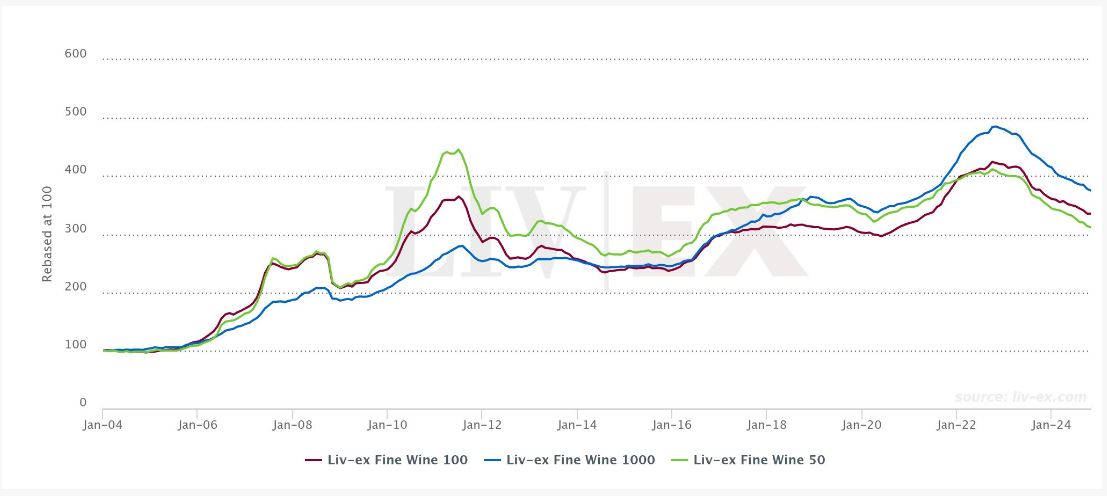
Before diving into the list, some market context. All major Liv-ex indices are down at least 9% year-on-year. The industry standard Liv-ex 100 is down 9.2%, the Liv-ex 1000 (the broadest measure of the market) is down 9.6%, and the Liv-ex Fine Wine 50, which tracks the performance of the 10 most recent physical vintages of the Left Bank First Growths (ie. the historical powerhouses) is down 12.5%. Of the Liv-ex 1000 sub-indices, the Italy 100 has weathered the storm better than the rest (down 4.1%).
In short, the market correction has continued, pretty much unabated. The two questions on everyone’s lips have been ‘Are we reaching the bottom?’ and ‘How much further can the market fall?’ The answers, broadly speaking, have been ‘No’ and ‘Until prices reach a point to clear out an excess of stock’. September saw the downturn accelerate. Perhaps enough stockholders were beginning to feel sufficient pressure to drop their prices in meaningful ways, rather than the steady death by a thousand cuts that had characterised the preceding months.
In that context, positive price performance – or even just an ability to limit one’s losses – has been hard to come by. In 2022, just 27 of the 422 brands that qualified for consideration in the Power 100 registered a negative price performance. This rose in 2023 to 216 (52.3%) of the 413 brands that made the cut. This year 343 (83.7%) of the 410 brands that qualified fell in value. Of the final 2024 Power 100, only 11 brands recorded a rise in their Market Price over the past 12 months.
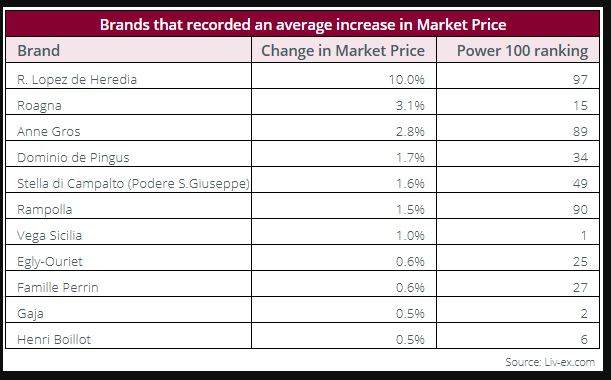
Beyond price pressure, the 2024 fine wine market has been characterised by two trends. First, activity has remained high – the number of wines traded has stayed consistent. We see this in the Power 100 – the count of trades for the 2024 list is 7.9% higher than for the 2023 list. Secondly, buyers have tended to be reluctant to take on stock that they can’t shift quickly, resulting in volumes traded falling 6.5%.
Therefore, it is not surprising that what we tend to see at the very top of the 2024 Power 100 list is an exaggerated view of last year, it being heavily skewed towards brands with higher volumes and, generally, a wide range of labels.
The dataset considered covers the year from 1st October 2023 to 30th September 2024. The rankings are then calculated based on several weighted criteria including price performance, the number of a brand’s wines traded and the cumulative value and volume of that trade over the selected period. You can read the full methodology at the end of the report.
Reginal Breakdown
Bordeaux – Survival of the fittest
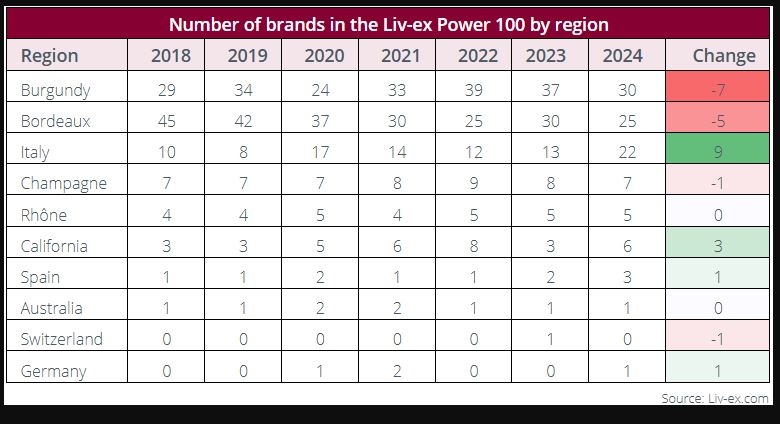
In last year’s Power 100, Bordeaux emerged as the beneficiary of Burgundy’s travails since the turn of the market in late 2022. As we wrote at the time: ‘[Bordeaux is] the least risky market, the best understood; collectors know what to expect from these wines, which is quality at a certain price, and relative liquidity’. 12 months later, not all the same can be said. It certainly remains the best, and most widely, understood – the mechanics are unchanged and liquidity is still its strength. However, in the current market, it is not necessarily the safest bet, in particular for recent vintages which have crashed through release prices pretty much across the board. Lafite is the prime example of Bordeaux’s dilemma. The number one brand in terms of traded value and volumes, its prices have, on average, fallen 18.1%.
There are five fewer Bordeaux brands in the Power 100 compared to last year, with the likes of Le Pin, Pichon Longueville Comtesse de Lalande, and Léoville Poyferré dropping out.
Burgundy – victim of its own success
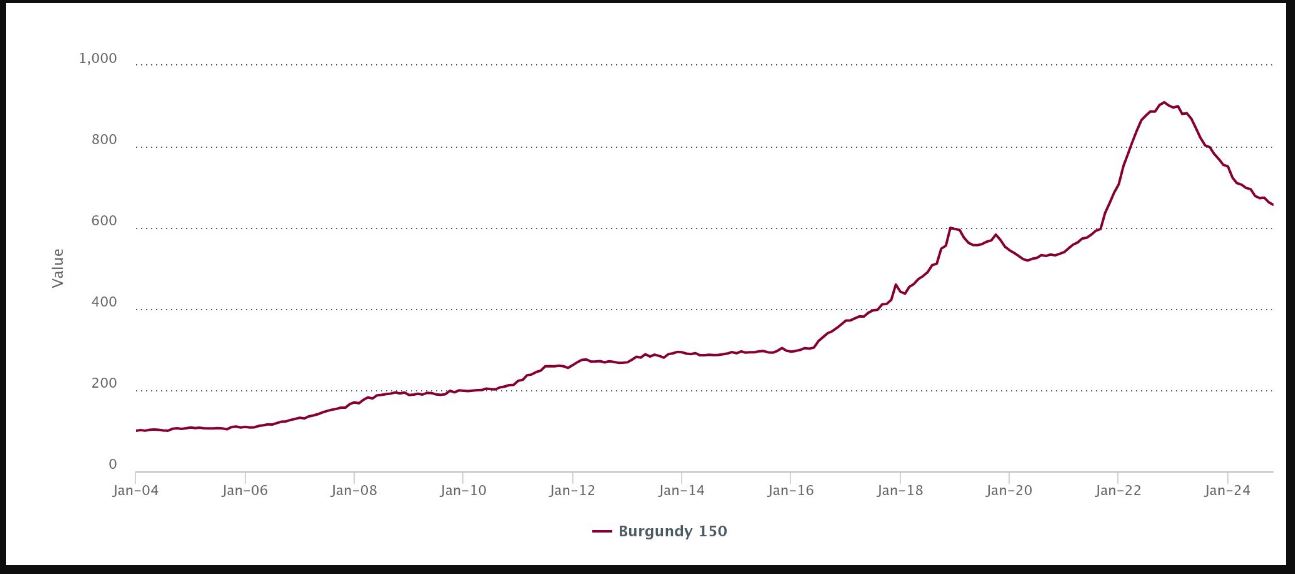
Given high volumes and accessible prices have characterised 2024’s biggest risers, it’s not surprising that Burgundy has fared badly this year. This is reflected in the Burgundy 150 index having fallen 14.7% over the past year, and 27.8% since the peak in October 2022. We also see the impact in this year’s Power 100, with seven fewer Burgundy brands in the list than last year. Nevertheless, Burgundy continues to be the best-represented region in the Power 100.
Variety of terroir is, for many collectors, the hook that inspired a passion for Burgundy. It is also the aspect of Burgundian wine that has prevented the region from faring any worse in this year’s Power 100. Burgundy brands take the top five spots in terms of number of unique wines traded. The Power 100’s methodology groups domaine, maison and négociant labels together. This of course increases the pool of wines and tips the scales in favour of the larger brands. It is thus no surprise that Drouhin, Bouchard Pere et Fils, and Louis Latour sit alongside and ahead of the very bluest of blue-chip producers near the top of the table.
Conclusion
As confidence has dissipated from the market, participants have gravitated towards brands that represent the least risky bets. While last year it looked like that meant Bordeaux, this year it means brands which share many stereotypically Bordelais traits – but not its terroir – that have risen to the top. Volume, liquidity, heritage brand, and prices that invite the uncorking of bottles are their calling cards. With the market still looking for a turning point, it is unlikely participants will be changing tack just yet.
Power 100 methodology
To calculate the rankings, we took a list of all wines that traded on Liv-ex in the last year (from 1st October 2023 to 30th September 2024) and grouped these by brand. As is now standard, Burgundy labels with both maisons and domaines were combined as one.
We then identified brands that had traded at least three wines or vintages and had a total trade value of at least £10,000.
Brands were ranked using four criteria: year-on-year price performance (based on the Market Price for a case of wine on 1st October 2023 with its Market Price on 30th September 2024); trading performance on Liv-ex (by value and volume); number of wines and vintages traded; and average price of the wines in a brand. The individual rankings were combined with a weighting of 1 for each criterion, except trading performance, which had a weighting of 1.5 (because it combined two criteria).
With the Power 100 ideology explaining the current situation of the wine market it does help to remove human verbal explanation.
On the whole the wine investment market in 2024 has experienced a mix of challenges and opportunities shaped by economic factors, regional trends, and shifting investor preferences.
Key Trends in 2024:
.
.
.
Final Outlook: While short-term pressures remain, including cautious buyer behaviour and an oversupply of certain vintages, the fine wine market’s diversification and its appeal as a hedge against traditional financial markets continue to attract investors. Experts at Capital Vintners suggest the potential for recovery, especially if global economic conditions improve and interest rates decline.
If you’re considering wine investments, now may be a strategic time to explore opportunities in well-established labels and scarce vintages while staying informed about market shifts.
In conclusion to our year end market report I would like to thank all our customers and suppliers for yet again all the business and support you have given to Capital Vintners and we look forward to 2025 being greater than the 2024.